.png)
As contextual targeting becomes the backbone of modern media buying, one assumption continues to quietly shape campaign planning, brand safety strategies, and audience modeling:
If the page is categorized correctly, the video on that page probably is too.
Our latest analysis suggests that assumption deserves a closer look.
Using Qortex’s Advanced Video Intelligence, we examined how contextual classification differs between page-level content and the video content embedded within it.
Methodology: Comparing Page vs. Video Context
For this analysis, the Qortex API returned IAB category classifications for both the page and the video associated with a set of URLs to identify structural patterns in how contextual classification behaves when video is treated as an extension of the page versus a distinct piece of content.
What We Observed at the Category Level
The results revealed consistent divergence between page and video context, especially as classification became more granular.
- Tier 1 Categories (broad contextual themes)
- The API returned Tier 1 classifications for both page and video hundreds of URLs.
- 70.3% of those URLs showed a mismatch between page-level and video-level Tier 1 categories.
- Tier 2 Categories (more granular subject matter)
- Tier 2 classifications were returned for those URLs.
- 89.98% of those URLs had a mismatch between page and video Tier 2 categories.
- Even when Tier 1 aligned
- Among URLs where page and video did match at Tier 1, 55% still diverged at Tier 2.
This pattern is important: alignment at a broad level often masks meaningful divergence at the level where buying, suitability, and performance decisions are actually made.
Why Granularity Matters More Than Ever

Tier 1 alignment may suggest surface-level compatibility, but Tier 2 divergence can signal something far more important: The viewer is being shown a video that serves a different informational or emotional purpose than the surrounding article.
Consider one example from the analysis:
- Page Category: Education
- Video Category: News and Politics
The article focused on a Bronx Science High School graduate accepted into 28 colleges. The embedded video, however, centered on Mayor Adams and immigration. From a human perspective, the mismatch is obvious. From a page-based contextual system, it may not be detected at all.
For advertisers, this creates risk and opportunity:
- Risk, because brand adjacency and audience intent may be misread
- Opportunity, because video-specific context can unlock far more precise alignment when analyzed independently
The Hidden Cost of Page-Level Assumptions
Many contextual systems still inherit assumptions from text-first environments:
- Videos are treated as supplements to articles
- Page taxonomy is used as a proxy for all embedded media
- Granularity is sacrificed for scale and speed
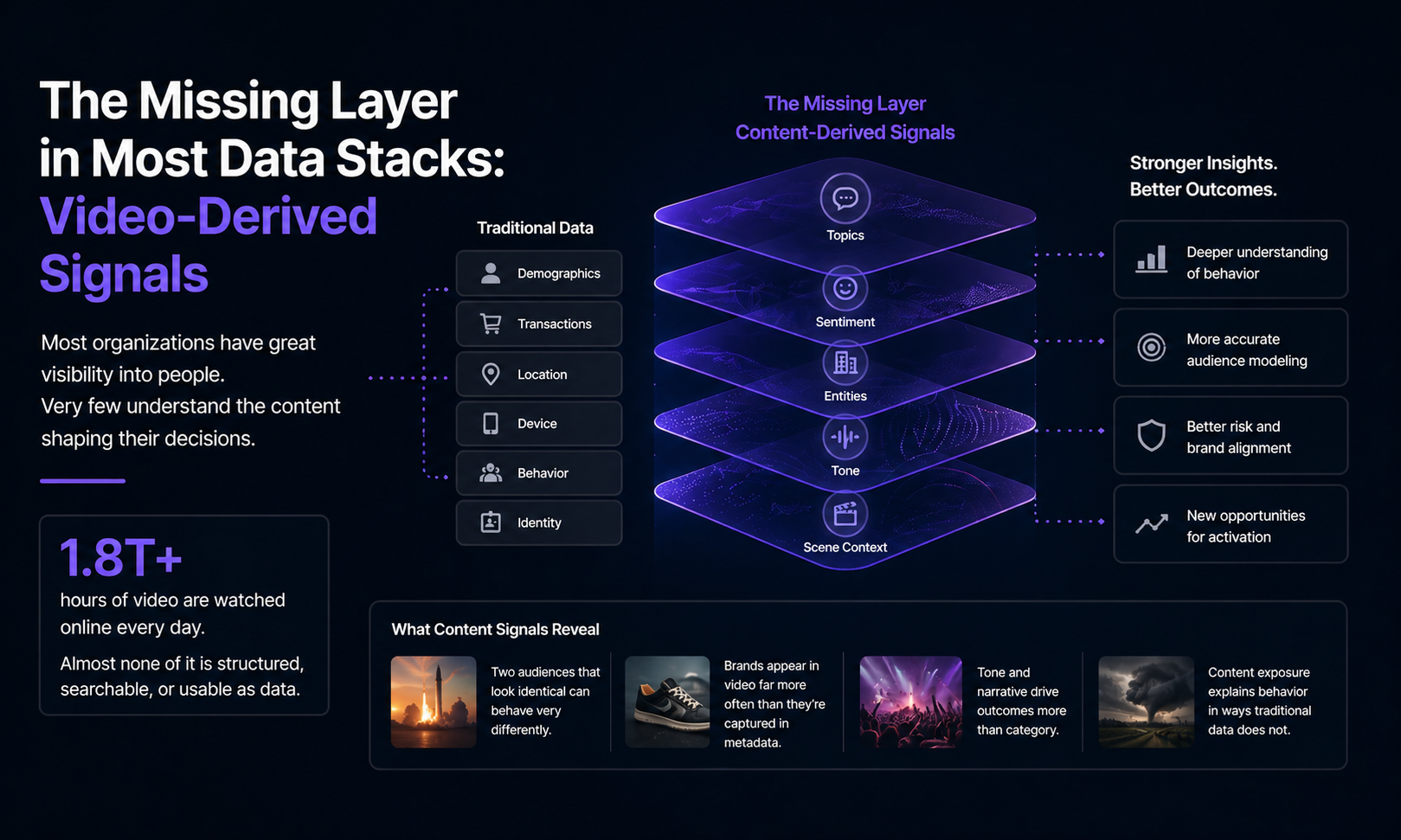
Our findings suggest that video behaves as its own contextual object, often reflecting a different narrative, tone, or informational focus than the surrounding page.
When contextual signals are flattened, advertisers lose the ability to:
- Distinguish informational intent from political discourse
- Separate human-interest storytelling from breaking news
- Align creative to the moment rather than the container
What This Means for Contextual Strategy
This research reinforces a key principle behind Qortex’s methodology:
context must be analyzed at the moment level, not assumed at the page level.
As publishers continue to embed multiple videos across evolving articles, and as video increasingly carries its own editorial agenda, contextual accuracy depends on treating video as a first-class signal, not a derivative one.
What Comes Next
The patterns we observed raise important questions for the industry:
- How often are advertisers optimizing against the wrong context?
- Where does Tier 1 alignment create false confidence?
- What happens to performance, suitability, and resonance when video context is evaluated independently at scale?
If context is the future of advertising, how we define and measure it matters just as much as where we apply it.
From Context to Better Outcomes
When video is understood on its own terms, contextual strategy becomes alignment. Knowing what a video is actually about, and who it resonates with, allows advertisers to match creative to content that feel relevant, not accidental.
That’s where performance improves.
Where Qortex Comes In
Qortex analyzes video context at the moment level and maps it to high-resonance audiences, without relying on page-level assumptions.
Interested in exploring how video context and audience alignment impact results?
Qortex can help you to run a deeper analysis across your content or creative, or build an audience that's right for you.