.png)
Every Super Bowl ad enters the same arena. The same audience. The same broadcast. The same impossible expectations.
But not every brand is trying to win the same way.
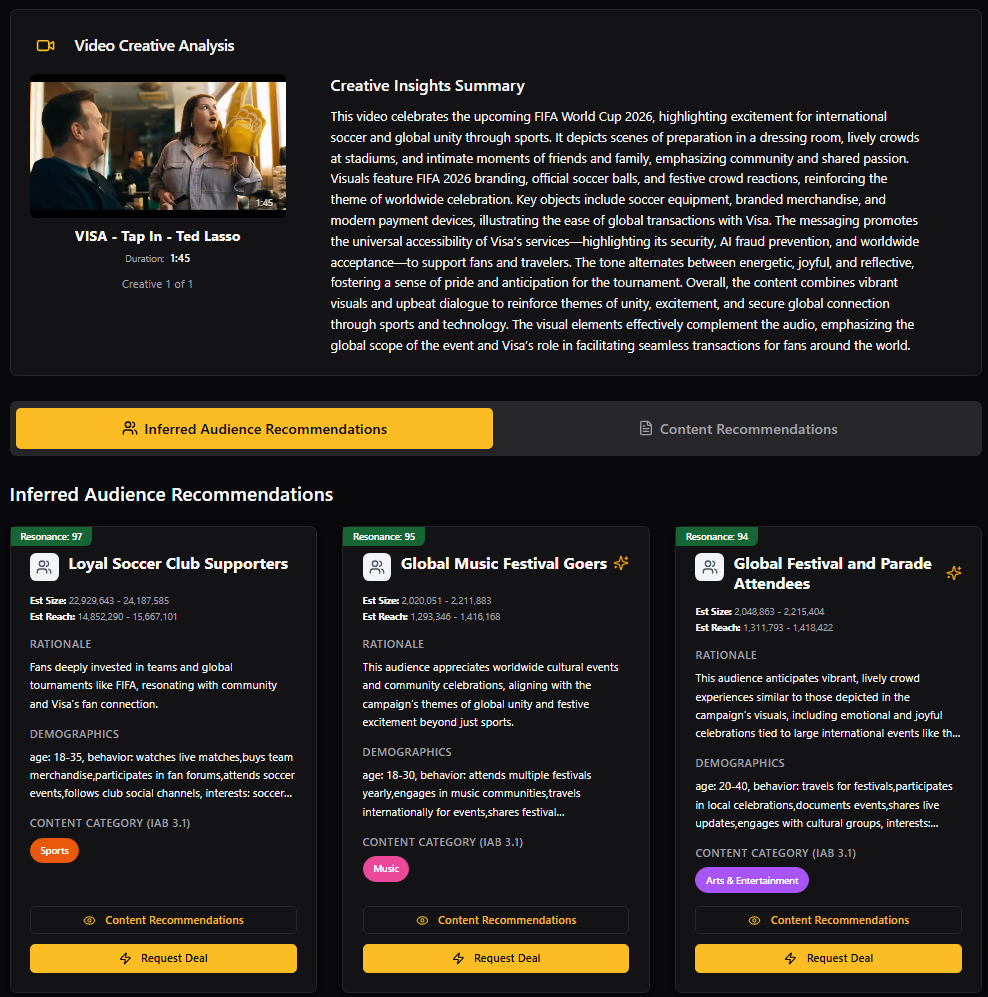
Using Qortex Advanced Video Intelligence, we analyzed three food delivery campaigns ahead of Super Bowl LX to understand which audiences each creative resonates with, how those signals expand beyond the obvious, and which brand appears best positioned to win the moment.
The brands analyzed:
Instacart. Grubhub. Uber Eats.
Each placed a very different bet.
Let’s get into it.
Instacart: Control Disguised as Spectacle
Instacart opens loud.
Music kicks in immediately. Bright lights. Inflatable produce. Exaggerated choreography. A disco-pop performance unfolds on a retro stage as performers sing about choosing bananas exactly how you like them.
Nothing here is subtle. That’s intentional.
The ad leans fully into performance, using humor and spectacle to earn attention in a room where no one is sitting quietly. Ben Stiller’s presence reinforces the tone. Familiar, comedic, and comfortable in absurdity. Benson Boone adds pop culture freshness. The creative feels designed to be reacted to, not decoded.
This is an ad that wants the room to notice it.
AVI confirms that instinct traveled exactly where it was meant to.
Audience: From group entertainment to household control
The assumed Instacart audience is convenience-driven. Busy adults who value time savings and efficiency. People solving grocery problems.
AVI confirmed that foundation. Instacart resonated strongly with Convenience Seekers, Casual Foodies, and Snack Time Strategists, reinforcing its role as an everyday utility.
But the strongest signal came from how the utility was framed.
Instacart’s top resonance clusters skewed toward shared experience and performance-driven mindsets:
- Sports Socializers
- Entertainment and Pop Culture Fans
- Group Gathering Hosts
- Casual Foodies
- Snack Time Strategists
Where the findings became more interesting was the unexpected overlap with Millennial Parents and DIY Customization Advocates. These audiences were not responding to the disco aesthetic itself. They were responding to the underlying message of control. Choosing your bananas is funny. It is also a proxy for reducing friction when you are shopping for other people.
The takeaway is subtle but important. This isn’t an ad about groceries. It’s an ad about control in chaotic moments, wrapped in entertainment so it can travel further.
Grubhub: Anticipation as a Statement
Grubhub opens quietly.
A long table. Polished silver. Carefully plated food. A covered trolley rolls in. The lid lifts. Faces react. The audience does not see what they see.
The spot ends before the payoff.
The presence of Matthew McConaughey and Bradley Cooper reinforces the tone. They are not playing for laughs. They signal intention, seriousness, and expectation. This creative does not rush. It assumes patience.
This is an ad that believes the reveal is worth waiting for.
AVI shows that confidence resonates, but not everywhere.
Audience: From food credibility to premium mindset
The assumed Grubhub audience is food-forward. People who care about quality, variety, and presentation.
AVI confirmed this core. Grubhub resonated most strongly with audiences defined by taste and cultural authority:
- Multi-Cultural Food Influencers
- Gourmet Food Lovers
- Luxury Lifestyle Aficionados
- Prime Time TV Viewers
- Celebrity Endorsement Fans
Where the signal expands is into tech-forward territory.
Unexpectedly strong resonance appeared among Tech Gadget Early Adopters and Tech-Savvy Urbanites. For these audiences, the teaser structure mirrors how premium products are introduced. The delayed reveal feels less like an ad and more like a launch moment.
The risk is environmental. In a Super Bowl setting defined by noise and interruption, anticipation needs a payoff strong enough to pull attention back in. Grubhub’s success will depend on whether the final reveal delivers contrast, not just polish.
The takeaway is clear. Grubhub is betting that prestige can still command attention in the loudest room of the year.
Uber Eats: Familiarity Wins the Room
Uber Eats does not wait for silence.
The Tiny Truths teasers drop viewers into small, strange moments. Puppets arguing. A pickup truck rolling through suburbia. A football mascot being interrogated. One word repeated until it becomes absurd.
The humor is intentionally repetitive. The tone is casual. Matthew McConaughey and Bradley Cooper appear not as stars, but as part of the bit. Their familiarity lowers the barrier to entry. The joke does not need explaining.
This creative feels like something you’ve already seen, even when you haven’t.
AVI shows that repetition is not a liability here.
Audience: From football ordering behavior to shared humor
The assumed Uber Eats audience is straightforward. People watching sports who want food delivered.
AVI confirmed that base. Uber Eats resonated strongly with:
- Football Fans Who Order In
- Sports Socializers
- Weekend Party Planners
- Food Delivery Enthusiasts
Where the signal expands is into humor-driven and domestic audiences:
- Humor-Based Social Sharers
- Family Game Night Hosts
- Casual Entertainers at Home
- Comedy Podcast Listeners
- Cultural Nostalgia Seekers
Despite polarized reactions online, these audiences show strong predicted alignment. In a football context, familiarity and repetition increase recall. Irritation does not necessarily suppress impact. It often reinforces it.
Uber Eats’ creative works because it matches how the Super Bowl is actually experienced. Distracted. Social. Repetitive. Food already on the brain.
Where the Audiences Overlap — and Where They Don’t
Looking across all three campaigns, the audience story becomes clearer when viewed side by side.
The shared ground
All three brands resonate with audiences tied to group viewing and food-centered moments. Sports Socializers, Group Gathering Hosts, and Prime Time TV Viewers appear across multiple creatives. This confirms a baseline truth: food delivery advertising during the Super Bowl must align with social behavior first, not individual intent.
The biggest divergence
Where the brands separate is how those moments are framed.
Instacart and Uber Eats both succeed with Entertainment and Humor-driven audiences, but they approach them differently. Instacart earns attention through spectacle and performance, while Uber Eats relies on repetition and inside jokes. These creatives overlap in social contexts, but diverge in tone.
Grubhub breaks away from both by leaning into prestige and anticipation, attracting Gourmet Food Lovers, Luxury Lifestyle Aficionados, and Tech-Savvy Urbanites that the other two largely do not capture. This creates a clear audience gap. Grubhub wins credibility-driven viewers but sacrifices some immediacy in chaotic viewing environments.
The notable gaps
- Instacart shows less pull with football-first loyalists compared to Uber Eats
- Uber Eats does not strongly capture premium or luxury-driven mindsets like Grubhub
- Grubhub has limited overlap with humor-first social sharers who dominate live Super Bowl conversation
These gaps are not failures. They are strategic choices. Each brand optimized for a different emotional context within the same event.
So Who Wins?
Each brand succeeds on its own terms.
Instacart wins attention and household relevance through performance.
Grubhub elevates food delivery through anticipation and prestige.
Uber Eats embeds itself into football culture through humor and familiarity.
The early leader: Uber Eats
Based on predicted resonance across football-driven behaviors, shared viewing contexts, and humor-forward audiences, Uber Eats holds the strongest early position.
Its creative aligns most closely with the emotional reality of game day. Recognition builds before kickoff, and repetition compounds impact rather than fighting for perfection in a single moment.
The Bigger Lesson
The Super Bowl does not have one audience. It has hundreds of emotional contexts happening at once.
Winning is not about being louder. It is about knowing where your creative fits, and who it fits with, before the ball is kicked.
Advanced Video Intelligence makes that visible.
Interested in seeing which audiences your ads are likely to resonate with, or activating a Super Bowl or live-event audience built around real content signals?
Sign up for AVI or request a custom event-based audience.