



Audience attention does not disappear. It reallocates.
This week, we saw a clear shift in where viewers spent their time, moving away from event-driven entertainment and toward hard news, consumer risk, and real-world consequences.
For advertisers, that shift matters.
.png)
From Stadiums to Headlines
.png)
Sports content dropped 34% week over week. Soccer fell 49%, college basketball 47%, and winter Olympic sports 61%.
The timing is not random.
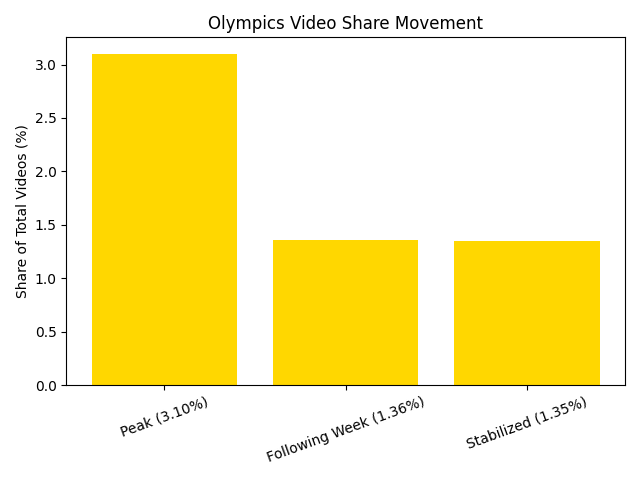
The Super Bowl is behind us, and the Olympics, now two weeks in, appear to be experiencing the typical post-launch taper. Tentpole events concentrate attention quickly, but they release it just as fast.
When that happens, audiences do not disengage. They redirect.
This week, that redirection was unmistakable.
Hard News and Regulatory Coverage Surged
.png)
News and Politics increased 24% week over week. The growth was concentrated in procedural and regulatory coverage:
Law up 43%
Crime up 60%
Disasters up 88%
Government Business up 144%
Financial Regulation up 316%
This type of spike signals event-driven engagement.
Recent drivers likely include continued Epstein file releases, high-profile House committee hearings, and heavy coverage around tax refund season and economic oversight. Financial regulation stories, consumer protection headlines, and federal scrutiny appear to be concentrating attention.
When audiences shift toward regulatory and consequence-based news, mindset shifts with them. Consumption becomes more serious, more evaluative, and more decision-oriented.
Automotive Safety Became a Flashpoint
.png)
Automotive rose 43% week over week.
Within that:
Auto Recalls up 151%
Auto Safety up 121%
Consumer Recalls up 164%
This aligns directly with a wave of recall headlines in the past two weeks:
Chrysler recalling more than 80,000 vehicles over rear coil springs that could detach while driving
Nissan recalling roughly 640,000 SUVs due to engine and gear issues
Hyundai recalling 2026 Kona SUVs over faulty steering components
BMW recalling nearly 87,000 vehicles due to engine starter defects
Expansion of the Takata airbag recall affecting millions of vehicles with “Do Not Drive” warnings
Mercedes recalling EV models amid battery fire concerns
When recall coverage stacks across multiple brands, consumer attention compounds. Automotive safety becomes a cross-brand narrative rather than an isolated issue.
For advertisers in automotive, insurance, warranty services, and financing, contextual alignment around safety and reliability becomes significantly more relevant during weeks like this.
Health and Household Protection Spiked
.png)
Medical Health rose 71% week over week.
Within that:
Birth Control up 200%
Pregnancy up 100%
Menopause up 400%
Reproductive Health overall up 67%
These increases likely correlate with ongoing legislative discussion, healthcare policy coverage, and viral social health conversations.
Parenting content rose alongside it:
Parenting Teens up 38%
Ages 4 to 11 up 45%
Babies and Toddlers up 129%
Internet Safety up 30%
Special Needs Parenting up 150%
Together, these categories signal a protective household mindset. Audiences were consuming information tied to family wellbeing, safety, regulation, and long-term stability.
Tech Hype Down, Practical Utility Up
Technology and Computing declined 38% week over week. Gaming dropped 32%.
But utility-focused tech categories rose month over month:
IT and Internet Support up 75%
Search-related content up 57%
During heavier news cycles, audiences often shift from aspirational or speculative tech content toward practical problem-solving information.
Utility rises. Hype fades.
The Bigger Pattern
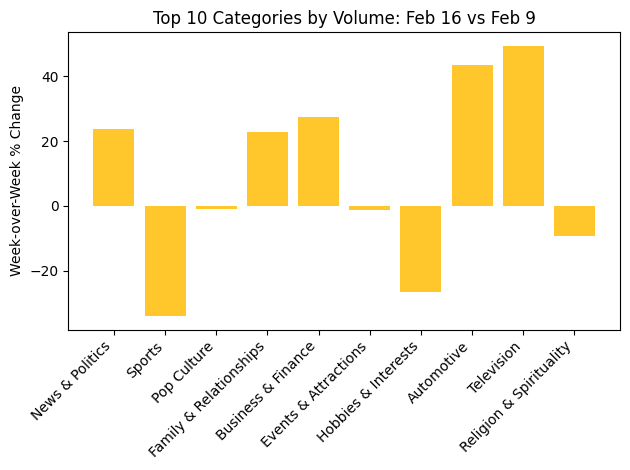
The story this week is not simply that Sports declined.
It is that attention migrated from entertainment and spectacle toward safety, regulation, and real-world consequences.
That shift aligns with:
Post Super Bowl normalization
Olympic tapering
Tax season financial awareness
Ongoing federal hearings and regulatory scrutiny
A concentrated wave of automotive recalls
Audience behavior reflects real-world context.
And it changes quickly.
Why This Matters for Advertisers
Context is not static. It moves with culture, news cycles, and consumer concern.
When attention shifts toward:
Safety and recalls
Financial regulation
Parenting and household wellbeing
Health and reproductive coverage
The emotional and cognitive state of the audience changes as well.
Brands that understand these weekly shifts can:
Align messaging to mindset
Increase relevance during high-attention moments
Avoid mismatched adjacency
Capture engagement when consumers are most attentive
.png)