The battle for voter attention is already underway. Political advertisers are entering the 2026 midterm cycle facing a media landscape that looks dramatically different than previous elections. Voters are consuming more content across more platforms than ever before.
Streaming has become mainstream, local news remains a trusted source of information, and issue-driven content often drives engagement far beyond traditional political media. At the same time, campaigns and advocacy organizations face increasing pressure to deliver results while navigating privacy regulations, signal loss, and growing concerns around data collection. The result is a fundamental shift in how political audiences are identified and reached.
This guide explores the current state of the 2026 election cycle, the issues and content categories driving voter engagement, and why contextual audience intelligence is becoming one of the most powerful tools available to political advertisers.
● $11.6 billion projected in 2026 political ad spending — the most expensive election cycle in U.S. history, surpassing both the 2024 presidential cycle and the 2022 midterm record
● 61.4% of all political engagement concentrated around political content, despite politics representing only 22.7% of tracked content inventory
● 7,640+ local news videos analyzed, making local news the single largest content category tracked
● 16.4% of engagement tied to disaster-relatedcontent, despite disaster coverage accounting for only 5.64% of tracked content
● Over 13,000 combined political audience signals analyzed across Democratic and Republican content ecosystems
Sources: Qortex AVI Platform content and engagement analysis; AdImpact 2025–2026Political Projections Report, updated June 2026.
The battle for voter attention is already underway.
Political advertisers are entering the 2026 midterm cycle facing a media landscape that looks dramatically different from previous elections. Voters are consuming more content across more platforms than ever before. Streaming has become mainstream, local news remains a trusted source of information, andissue-driven content often drives engagement far beyond traditional political media.
At the same time, campaigns and advocacy organizations face increasing pressure to deliver results while navigating privacy regulations, signal loss, and growing concerns around data collection.
This guide explores the current state of the 2026 election cycle, the issues and content categories driving voter engagement, and why contextual audience intelligence is becoming one of the most powerful tools available to political advertisers.
The 2026midterm cycle has officially become the most expensive midterm election in U.S.history — and the most expensive election cycle of any kind, surpassing the $11.2 billion spent during the 2024 presidential race.
According to AdImpact's Political Projections Report, updated June 2026:
● Total political advertising spending is now projected to reach $11.6 billion, up from AdImpact's earlier $10.8 billion estimate — more than 30% increase over the 2022 midterm cycle.
● Senate races alone are projected to draw roughly $3.4billion, with Texas' Senate primary among the single most expensive races on record.
● Congressional races (House and Senate combined) are on pace for record spending, with House spending crossing $2 billion for the first time in history.
● Connected TV spending has been revised upward to approximately $2.7 billion, maintaining its position as the fastest-growingmedia type in political advertising.
● Downballot and state legislative spending are also on pace for records, with a combined projected spend of $3.7 billion.
Source: AdImpact, "AdImpact Reveals 2026 Election Cycle to Reach Record $11.6 Billion in Ad Spending," June 2026.
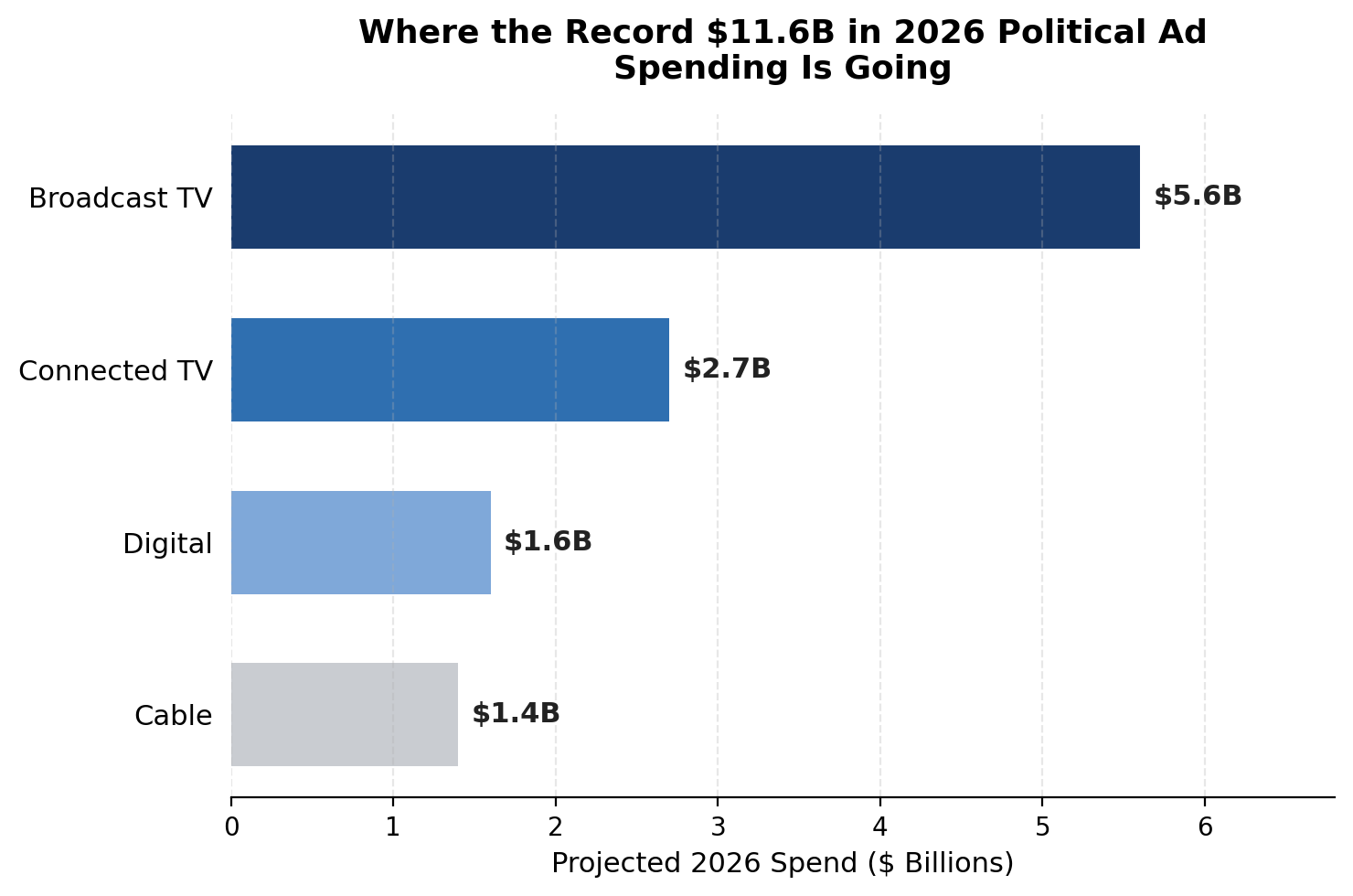
The intensity of competition is being driven by several factors:
● A narrow balance of power in Congress
● Competitive Senate and House races across multiple battleground states, including Texas, Ohio, and Maine
● High-profile gubernatorial contests in states including New Jersey, and Georgia — three of the four most expensive advertising gubernatorial races on record
● Continued growth of issue-based and advocacy advertising
As spending increases, efficiency becomes increasingly important. Reaching the right voters is no longer simply a matter of buying more impressions. It requires understanding where voter attention actually exists.
Traditional political advertising has long relied on demographic data, voter files, party registration records, and modeled audience segments.
While these approaches remain valuable, they often fail to capture what voters care about in real time.
A voter'sinterests change throughout an election cycle.
A parent may become focused on education after a local school board controversy. A homeowner may suddenly become concerned with insurance, infrastructure, or emergency following a natural disaster. A community may become highly engaged with public safety issues following a local event.
These moments create opportunities for campaigns to reach voters through the content they are actively consuming rather than relying solely on historical assumptions.
This is where contextual intelligence becomes increasingly valuable. Rather than targeting based on who someone was, contextual advertising focuses on what people are engaging with right now.
Success today requires more than broad demographic targeting or voter file matching. It requires understanding the issues, conversations, and moments that are actively capturing audience engagement.
Qortex helps political advertisers move beyond static audience profiles by leveraging contextual intelligence across premium video, Connected TV, and digital environments. Our AI-powered platform analyzes content at scale, identifying the topics, sentiment, and moments driving audience attention in real time.
This allows advertisers to reach voters based on what they care about right now — whether that's public safety, healthcare, immigration, education, infrastructure, the economy, or emerging political issues.
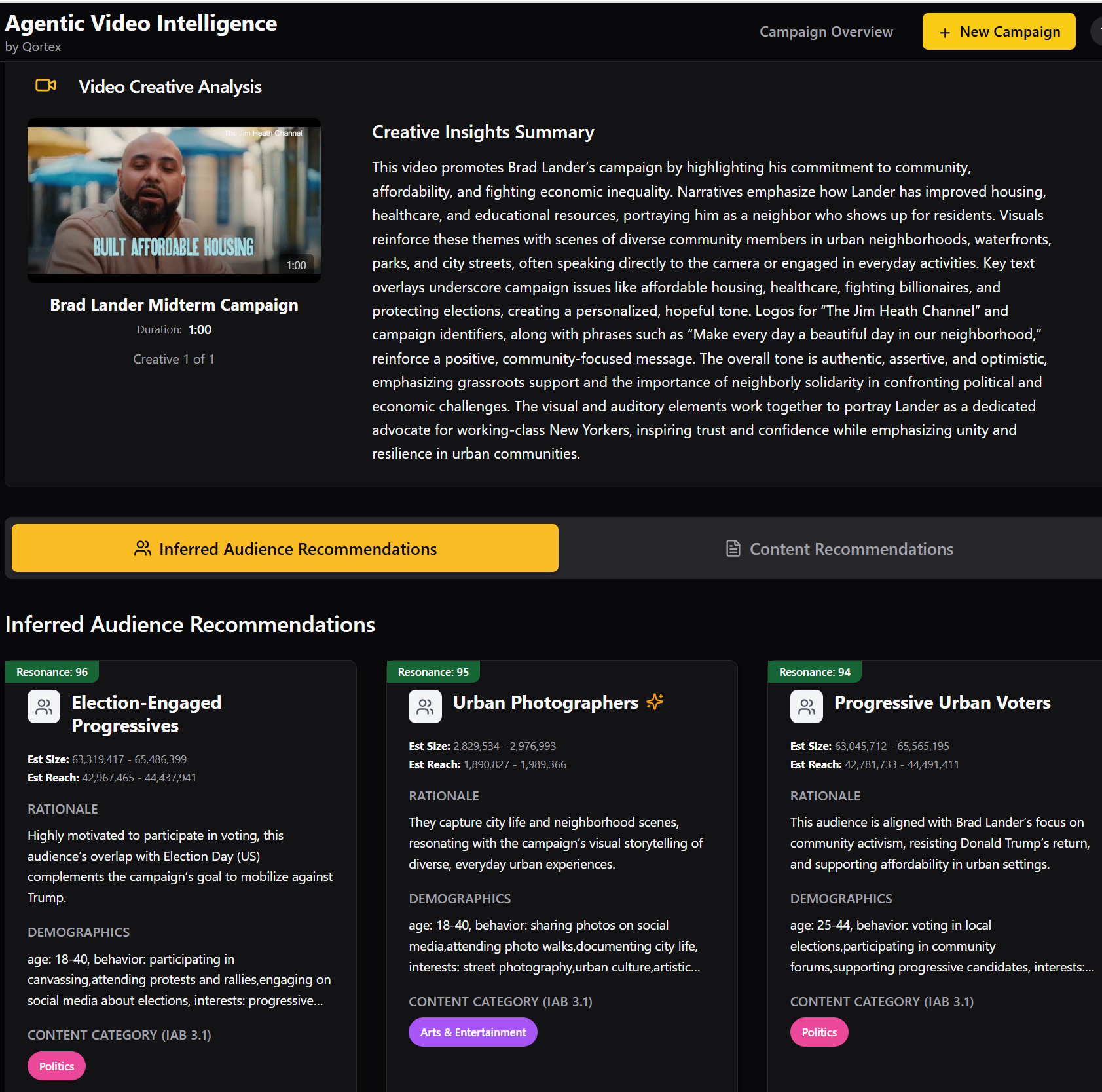
Key audiences for Brad Lander, Runner for New York Congressman include urban voters, grassroots political supporters, civic tech enthusiasts, urban gardeners, working-class new yorkers. All of these suggested audiences are returned based off of what the video is about, what is shown, the sentiment in the video and other key meta signals derived.
Unlike traditional audience solutions, Qortex combines contextual intelligence withreal-time content understanding to help advertisers:
● Reach issue-based voters at scale
● Activate privacy-first audiences without relying on sensitive personal data
● Align the election cycle
As campaigns become more focused on persuasion, efficiency, and privacy compliance, contextual intelligence provides a smarter path forward.
Whether you're supporting a candidate, advocacy effort, ballot initiative, or public affairs campaign, Qortex helps ensure your message appears alongside the conversations that matter most.
Qortex analyzed engagement across major political and news-related content categories to better understand where audience attention is concentrated.
The findings reveal a significant gap between content volume and audience engagement.
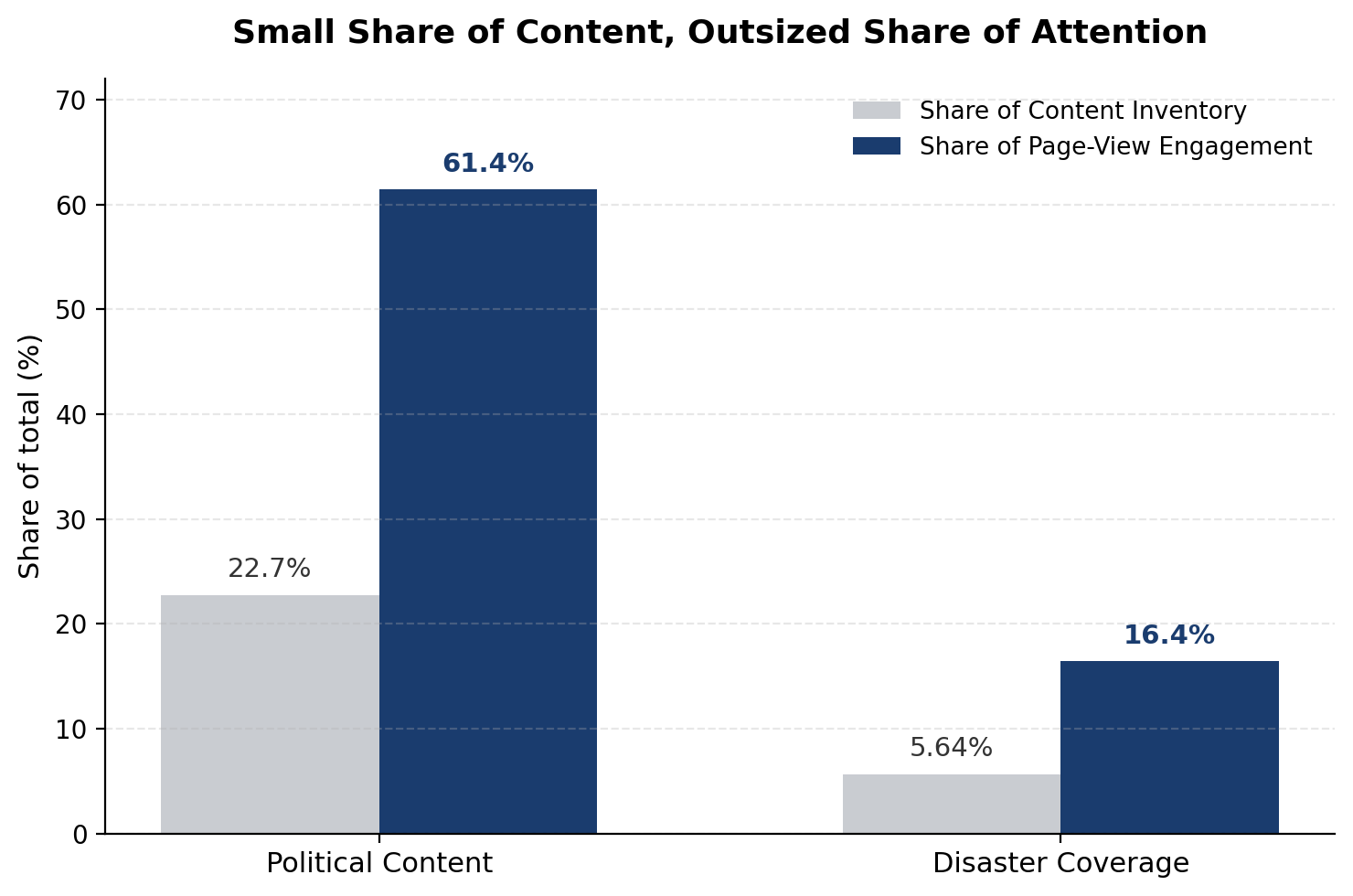
While political content represented only 22.7% of tracked video inventory, it generated 61.4%of associated page views.
This indicates that political content consumers are highly engaged and actively seekinginformation rather than passively consuming content.
For advertisers, this creates opportunities to align messaging with audiences already demonstrating strong interest in political issues and public affairs.
The political advertising industry has spent the last decade grappling with the risks ofidentity-based targeting.
In 2018, the Cambridge Analytica scandal exposed how personal data from millions of Facebook users was used to build voter profiles and target political messaging, sparking global privacy concerns and regulatory scrutiny.
More recently,UK political party Reform UK faced criticism in 2024 after reports allegedwebsite visitor data was being shared with advertising platforms without proper consent. That same year, the FTC took action against data brokers Mobilewalla and Gravy Analytics for collecting and selling sensitive location data thatcould reveal attendance at political events, religious institutions, and healthcare facilities.
These cases highlight a growing reality: consumers, regulators, and advertisers are increasingly questioning how personal data is used for audience targeting.
Contextual intelligence offers a different approach. Rathsonaler than targeting people based on per profiles, contextual advertising focuses on the content they are actively engaging with — allowing political advertisers to reach audiences through the issues, conversations, and topics that matter most without relying on sensitive personal information.
Local news accounted for 33.3% of all tracked content — the largest content category analyzed, drawn from more than 7,640 local news videos.
While local news generated a smaller share of overall page views than politics, it remains one of the most important contextual environments for voter engagement.
Many voters encounter political information through:
● Community reporting
● Local government coverage
● School board discussions
● Infrastructure updates
● Public safety reporting
● Regional economic news
For campaigns,local news often provides a more natural and trusted environment forissue-based messaging than explicitly political content.
One of the most su findings from Qortex's analysis involved disaster-related content.
Disaster coverage represented only 5.64% of tracked videos but generated 16.4% of associated page views — a level of engagement that significantly outperforms the category's share of available content.
Disaster-related content frequently intersects with issues such as:
● Emergency preparedness
● Infrastructure investment
● Climate resilience
● Insurance policy
● Government response
● Community recovery
These moments create highly engaged audiences that may not traditionally be classified as political but are actively consuming content related to public policy and governance.
One of the most interesting findings from Qortex's analysis is that voters are not consuming content exclusively from their own political perspectives.
Democratic audiences showed significant engagement with content discussing:
● Republican Party activity
● GOP leadership
● Congressional investigations
● Judicial developments
● Government accountability
Meanwhile, Republican audiences demonstrated strong engagement with:
● Election activity
● Campaign developments
● Polling
● State government coverage
● Legislative contests
These patterns suggest that voters increasingly monitor both sides of the political conversation. Rather than existing in isolated media bubbles, many voters actively consume information about opposition candidates, competing policies,and major political events.
This creates opportunities for campaigns to identify issue-driven audiences based on engagement behavior rather than party affiliation alone.
The future of political advertising will require balancing effectiveness with consumer expectations around privacy.
Third-partycookies continue to decline in value. Consumers are increasingly aware of how their information is collected and used. Regulatory scrutiny continues to increase.
As a result, advertisers need solutions that can deliver relevance without relying on invasive tracking methods.
Contextual audience intelligence provides a privacy-first alternative. By understanding the content environments consumers actively engage with, advertisers can:
● Reach relevant audiences without collecting personal identifiers
● Align messaging with current interests and concerns
● Improve campaign efficiency
● Maintain compliance with evolving privacy standards
● Build trust with voters
For political campaigns, advocacy groups, nonprofits, and issue organizations, this approach offers a scalable way to connect with audiences while respecting consumer privacy.
The 2026 midterm cycle will set records for spending, competition, and media f — and the most expensive stretch of the cycle is still ahead. Historically, 58–67% of all political ad spending lands between August and Election Day, with October alone accounting for 28–36% of total spend.
Source: AdImpact, via CNBC, "2026 election ad spend projected to reach record," June 2026.
Success will increasingly depend on understanding not just who voters are, but what they care about in the moment.
Political audiences are revealing their interests every day through the content they choose to watch, read, and engage with. The organizations that can identify and activate those signals will gain a significant advantage in reaching voters more effectively.
Contextual intelligence provides the bridge between voter attention and political messaging. And in an environment where every impression matters, understanding context may become one of the most valuable advantages available to political advertisers.
Qortex helps campaigns, advocacy organizations, agencies, and political advertisers reach audiences based on real-time contextual intelligence across video, ConnectedTV, and digital environments.
Ourprivacy-first audience solutions allow organizations to connect with voters based on the issues, topics, and moments that matter most.
Whether you're activating around healthcare, public safety, education, infrastructure, economic issues, or emerging political conversations, Qortex helps ensure your message reaches audiences in the right context.
Book a strategy session with Qortex to explore custom political audience solutions for the 2026 election cycle.
Sources
● AdImpact, "AdImpact Reveals 2026 Election Cycle to Reach Record $11.6 Billion in Ad Spending," June 2026 (updates theoriginal 2025–2026 Political Projections Report).
● Wesleyan Media Project, New Studies Published on Television and DigitalAdvertising in the 2022 Midterms.
● Wesleyan Media Project, New Studies Published on Television and DigitalAdvertising in the 2024 Elections.
● Wesleyan Media Project, Ad spending totals $700 million in the past two months,reaching $1.7 billion cycle-to-date (May 14, 2026 — this is therelease the original draft cited as the "May 2026 Political AdvertisingSpending Update").
● OpenSecrets, "Political ad spending is projected to reach a newhigh in 2026 midterms" — Senate/House spending record figures.
● Qortex AVI Platform content and engagement analysis.(Internal source — no public link; verify current figures with the data teambefore publishing.)
