


Most brands still plan around peaks. But the data shows a more nuanced reality: the most valuable opportunities often exist before and after the moment everyone is chasing.
To illustrate this, let’s use the Olympics as an example. Not because it’s unique, but because it clearly demonstrates a pattern that applies to any major cultural moment.
The Myth of the “Two-Week Spike”
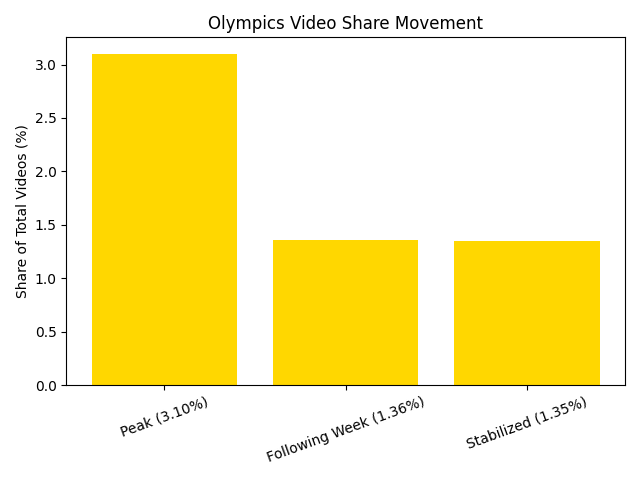
Most brands treat large-scale events like short-lived surges. The data tells a different story.
Across video analysis during the Olympics:
- Olympic share peaked at 3.10% of total video volume
- Volume surged +118% week over week at peak
- The following week dropped -56%
- But stabilized at 1.35% of total share
The spike was sharp. But more than 40% of peak attention remained active after the surge.
That post-peak “floor” is where many brands stop paying attention. It’s also where efficiency begins.
Key insight: Attention doesn’t disappear after the peak. It redistributes.
Attention Doesn’t Drop. It Shifts.
As Olympic content compressed, other categories accelerated:
- Hockey rebounded +58.6% week over week
- Figure skating surged +173% during peak competition windows
- Curling jumped +300% at its high point
- Snoop-related content rose +333% and remained elevated
This isn’t random. It’s directional.
When a major moment peaks, attention fragments into smaller, high-momentum pockets.
The Power of Personalities as Signal Multipliers
One of the clearest signals in the data wasn’t tied to a sport. It was tied to a person.
- Snoop-related content increased from 0.03% to 0.13% of total video share
- A +333% lift in just two weeks
- And critically, it remained elevated even after Olympic volume declined
What this means: Cultural figures extend the lifespan of attention. They act as amplifiers that carry engagement beyond the event itself.
For advertisers, this creates a powerful opportunity to target moments through personalities, not just events.
Category Volatility Creates Opportunity
Some categories act like volatility engines:
- Figure skating surged +173%, then dropped -53%, followed by another -20% decline
- Curling showed +300% growth, then stabilized at 0.10% share
These categories don’t offer sustained scale. They offer sharp, emotional spikes tied to specific moments.
What this means: Brands that monitor short-cycle volatility can align with high-intensity engagement windows that are often overlooked and less competitive.
The Rebound Effect in Live Content
Live sports show a different pattern:
- Hockey declined to 0.87%, then rebounded to 1.38%
- A +58.6% recovery week over week
Even without reaching Olympic-level scale, these categories demonstrate strong elasticity tied to performance and timing.
What this means: Demand is reactive. Real-time context creates immediate opportunity for brands that can move quickly.
The Predictable Pattern Behind Every Cultural Moment
Across every category, the same lifecycle emerges:
- Baseline
- Acceleration
- Peak
- Compression
- Stabilized floor
Most strategies are built around the peak.
But the data shows that the stabilized floor is where efficient, scalable opportunity often lives.
Where Smart Brands Focus
Looking at the Olympic example:
- Olympic content stabilized at 1.35% share
- Hockey rebounded +58%
- Snoop remained 4x above baseline
- Figure skating normalized after a 173% spike
This reinforces a core truth:
Attention doesn’t disappear. It redistributes.
The Strategic Takeaway
Winning brands don’t just chase spikes. They map attention as it moves.
That means:
- Identifying momentum before peak pricing hits
- Capturing demand during high-intensity windows
- Scaling efficiently during post-peak normalization
- Leveraging personalities and adjacent content to extend reach
With Advanced Video Intelligence, Qortex enables brands to understand these shifts in real time and align campaigns to where attention is going, not just where it has been.

.png)