Placement Is Not the Same as Perception
There’s an assumption built into most measurement and brand safety frameworks that placement is a reliable proxy for experience.
If something runs in the right category, on the right publisher, within the right guidelines, then the outcome should follow.
In practice, it rarely works that cleanly.
Two videos can sit in the same category and still create completely different contexts for a brand.
One might feel calm, informative, and aligned with the message being delivered. The other might feel emotionally charged, chaotic, or subtly negative, even if it technically meets every safety requirement.
From a reporting standpoint, they look identical.
From a human standpoint, they are not.
The Gap That Doesn’t Show Up in Reporting
We’ve seen this play out across campaigns run by large agencies and global brands.
Content that passes every standard filter can still vary widely in tone, narrative, and emotional context. And that variation has a direct impact on how a brand is perceived in the moment.
In some cases, videos categorized as “news” or “general content” included topics like:
- coverage of violent incidents involving law enforcement
- discussions around nuclear conflict and global instability
- stories involving harm or risk to children
- highly charged political or conspiratorial commentary
None of this content was flagged as unsafe by traditional standards. It sat within acceptable categories and passed standard filters.
But the tone, framing, and subject matter created an environment that many brands would not intentionally choose.
It’s not about whether the content violates a rule.
It’s about whether it creates the right association.
Most Brand Risk Isn’t Unsafe. It’s Misaligned.
Most systems are designed to identify risk in binary terms. Something is either safe or it isn’t.
But that’s not how the real world works.
A large portion of content sits somewhere in between. It’s technically safe, but contextually questionable. It doesn’t trigger any filters, but it doesn’t feel right either.
That’s where perception starts to shift.
And because it doesn’t show up as a clear violation, it often goes unnoticed.
What’s Missing Is the Experience Itself
Today’s systems are very good at answering where something ran.
They are far less effective at explaining what it felt like.
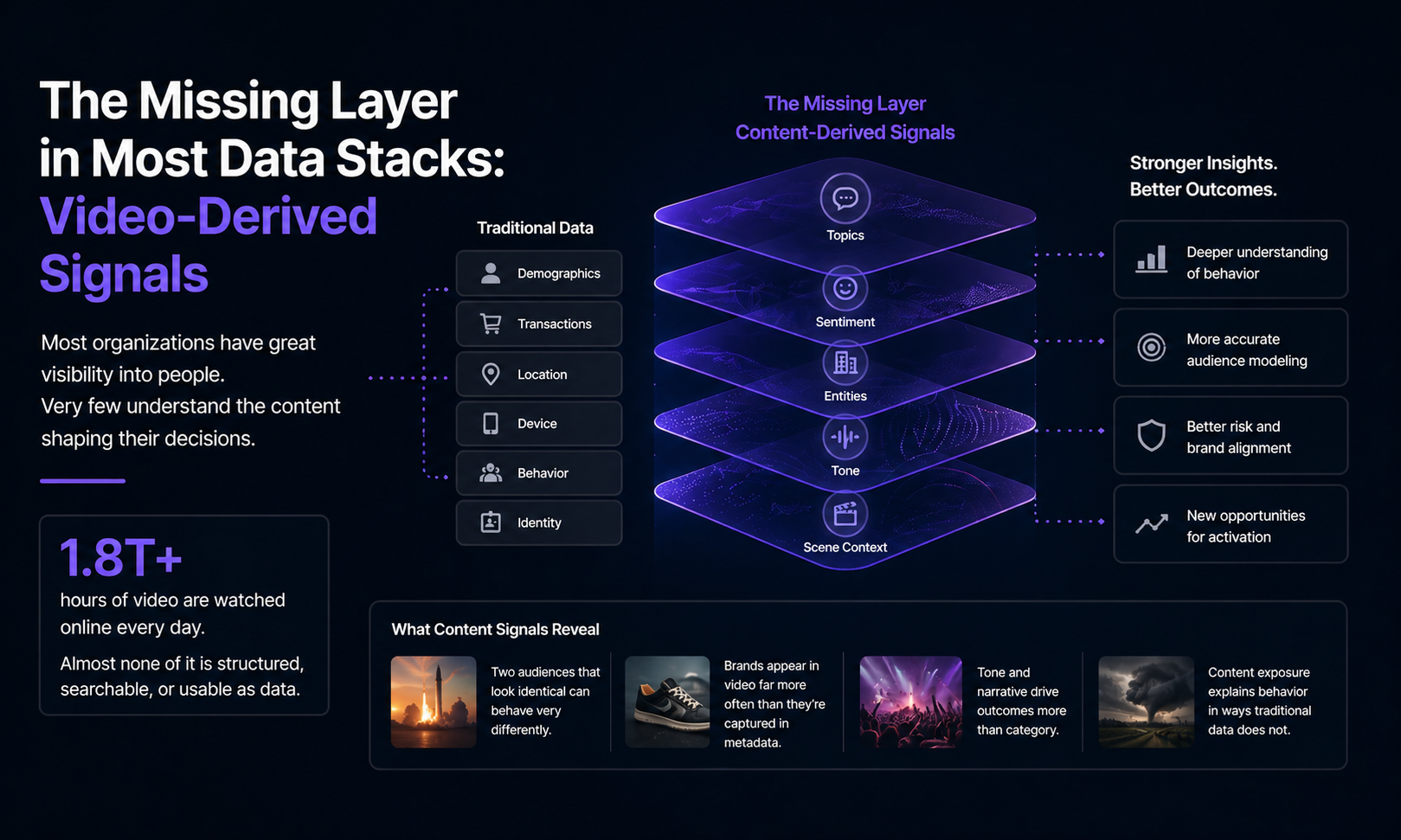
That’s a problem, because video is not just information. It’s an experience shaped by tone, pacing, narrative, and visual context.
When a brand appears inside that experience, it becomes part of it whether that was the intention or not.
The Shift That’s Starting to Happen
There’s a growing recognition that placement alone isn’t enough.
Understanding content at a deeper level, how it comes across, how it feels, what it signals, is becoming just as important as knowing where it lives.
That changes the conversation.
It moves it away from categorization and toward interpretation. Away from tracking exposure and toward understanding experience.
Because That’s What People Actually Remember
Audiences don’t remember where they saw something.
They remember how it made them feel.
And when your brand is part of that moment, it inherits some of that feeling whether it aligns with your intent or not.
If You’re Curious What That Actually Looks Like
We’ve been looking at this problem from a different angle, analyzing video at the level of tone, sentiment, and context rather than just category and placement.
If it’s useful, we’re happy to share a few examples and walk through what we’re seeing.