Creative Doesn’t Work Alone. Context Decides If It Works at All.
Creative has never operated in a vacuum.
It exists inside environments. Inside content. Inside moments that shape how it’s received in real time.
And increasingly, context is the difference between something that resonates and something that disappears.
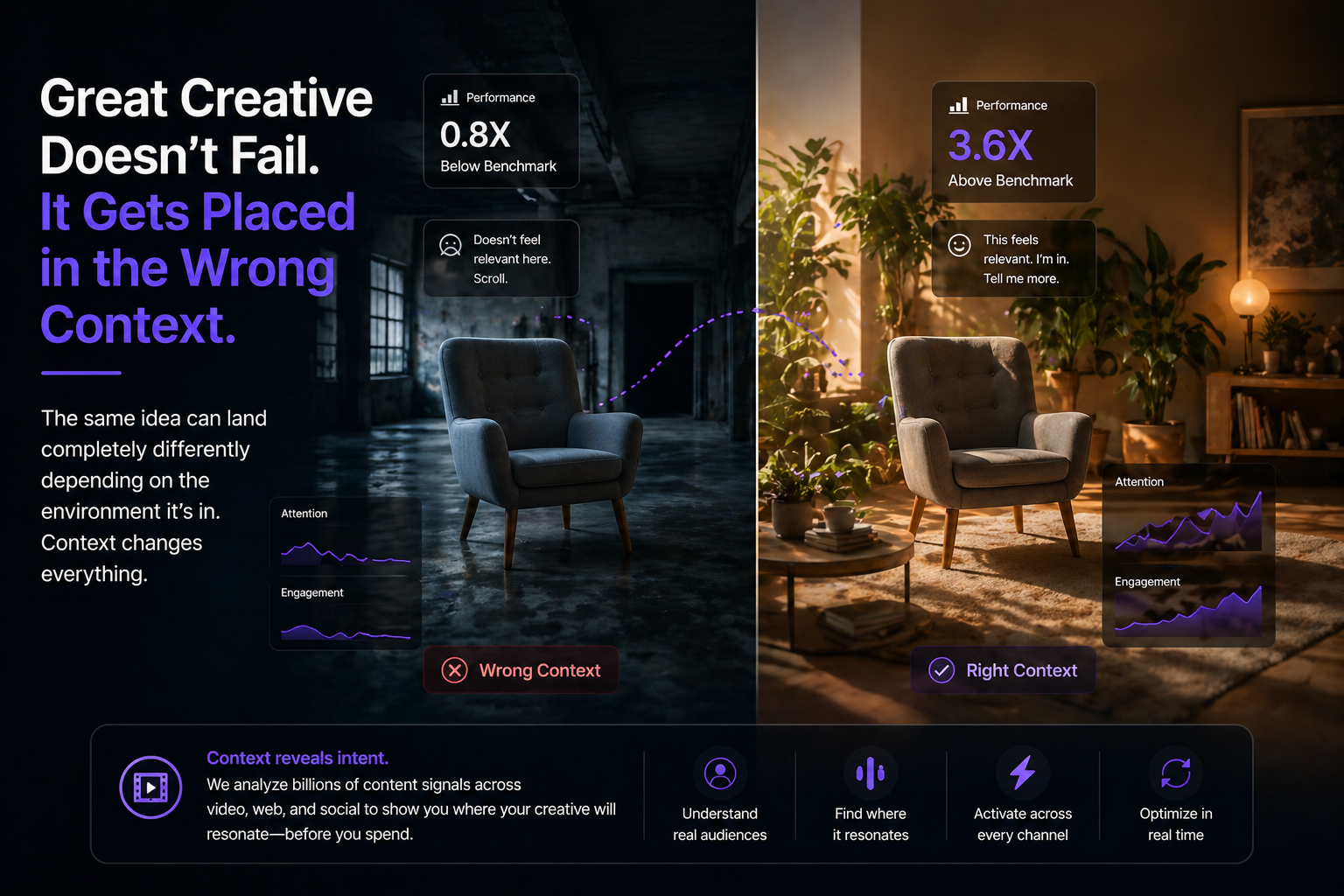
Two identical ads can deliver completely different outcomes depending on where they appear. One feels natural. The other feels intrusive. One earns attention. The other gets skipped in seconds.
The idea didn’t change.
The moment did.
The hidden variable behind performance
Most marketing frameworks still follow a familiar structure:
Define the audience
Develop creative for that audience
Distribute efficiently across media
On paper, it works.
In practice, it breaks more often than teams expect.
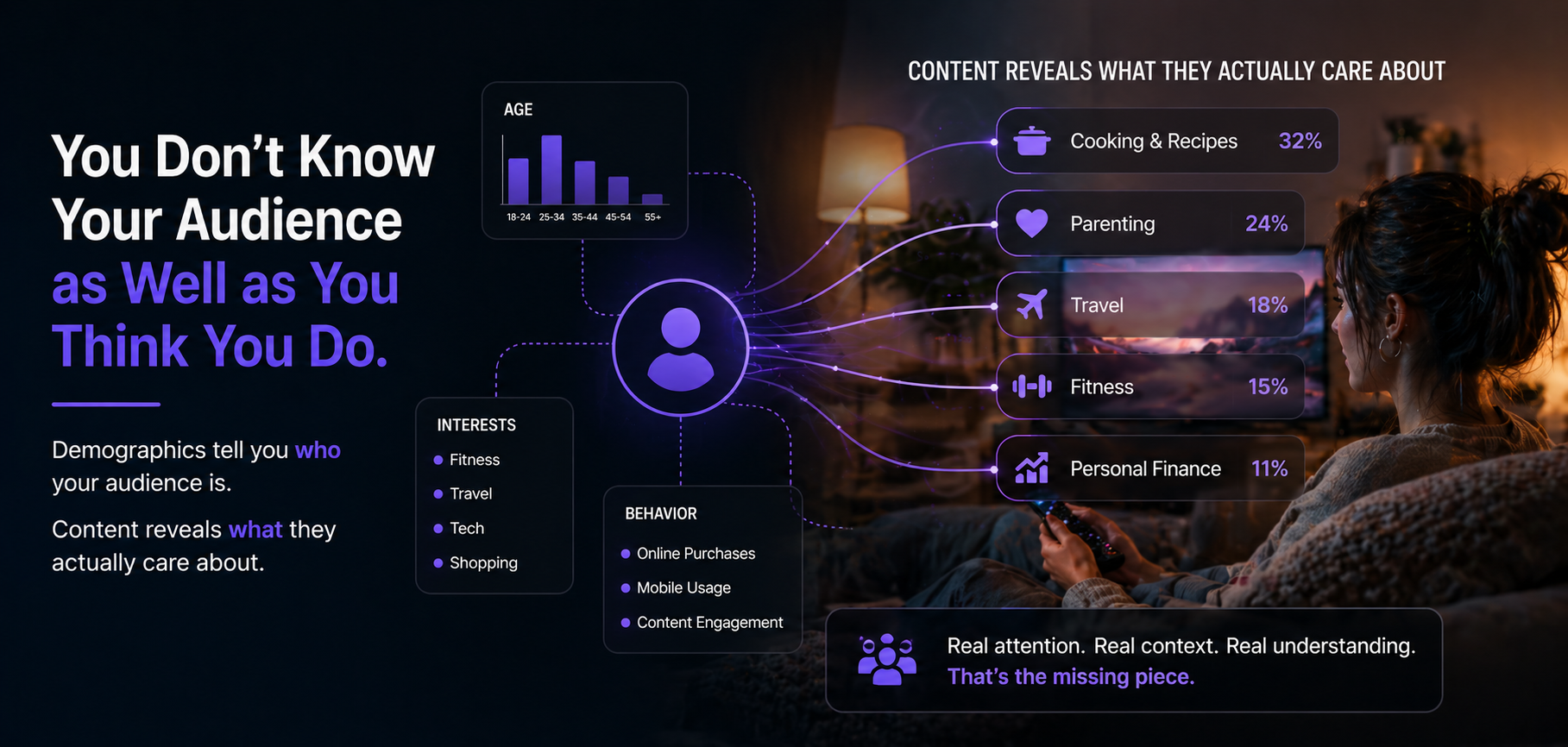
Because audience data describes people, not the moments they’re in.
It can tell you who someone is, what they’ve done, and what they might do next. It doesn’t capture what they care about right now, in the context they’re actively engaged with.
And that gap shows up in performance.
Research continues to reinforce this shift:
- Attention can vary by up to 5x depending on the surrounding content environment (Lumen Research)
- Ads aligned with content drive significantly higher brand recall and favorability (Integral Ad Science)
- Contextually relevant environments increase purchase intent by more than 60%
The takeaway is straightforward.
The same person behaves differently depending on the moment they’re in.
When “perfect targeting” still misses
We’ve seen this play out across campaigns.
A fitness-focused campaign performing best inside parenting content.
Entertainment creative outperforming expectations in news environments.
Highly aligned placements underdelivering while unexpected ones drive the majority of engagement.
This isn’t randomness.
It’s a context mismatch.
Two users may look identical in a dataset. Same demographics. Same interests. Similar behaviors.
But place them in different content environments, and their mindset shifts.
One is passively scrolling. Another is actively engaged. One is emotionally invested. Another is distracted.
That difference determines whether an ad connects or gets ignored.
Why creative feels “off” more often than it should
When creative underperforms, the instinct is to question the work.
Was the message wrong?
Was the hook weak?
Do we need new variations?
Sometimes that’s the right call.
But often, the issue is placement, not the idea itself.
Even strong creative struggles when it appears in a moment that doesn’t support it.
And average creative can outperform expectations when it aligns with what someone is already watching, reading, or feeling.
A shift in how performance gets evaluated
More teams are starting to rethink how they approach this.
Instead of focusing only on whether the audience is correct, they’re looking at how well the message fits the moment.
This changes how campaigns are built and optimized.
It introduces a more dynamic layer into decision-making. One that reflects real engagement instead of relying entirely on predefined segments.
Because when creative aligns with context, it integrates more naturally into the experience. It captures attention more effectively. It drives stronger outcomes without forcing relevance.
The opportunity most teams still miss
Recognizing that context matters isn’t the challenge.
The challenge is having visibility into it.
Most teams still rely on post-campaign reporting to understand what worked. By the time those insights are clear, the campaign is already over.
The opportunity is earlier in the process.
Understanding where a message fits before it runs. Identifying which environments amplify it. Seeing which moments work against it.
That’s where meaningful performance gains are still largely untapped.
The bottom line
Creative doesn’t fail because it’s ineffective.
It fails because it shows up in the wrong place, at the wrong moment, in the wrong mindset.
And when it shows up in the right one, it doesn’t feel like an interruption.
It feels like it belongs.
If you’re interested in how creative maps to real-world video content and moments, Qortex approaches this through a different lens, analyzing the context inside video itself to surface where messaging is most likely to work.