The Reality of Travel Content Performance
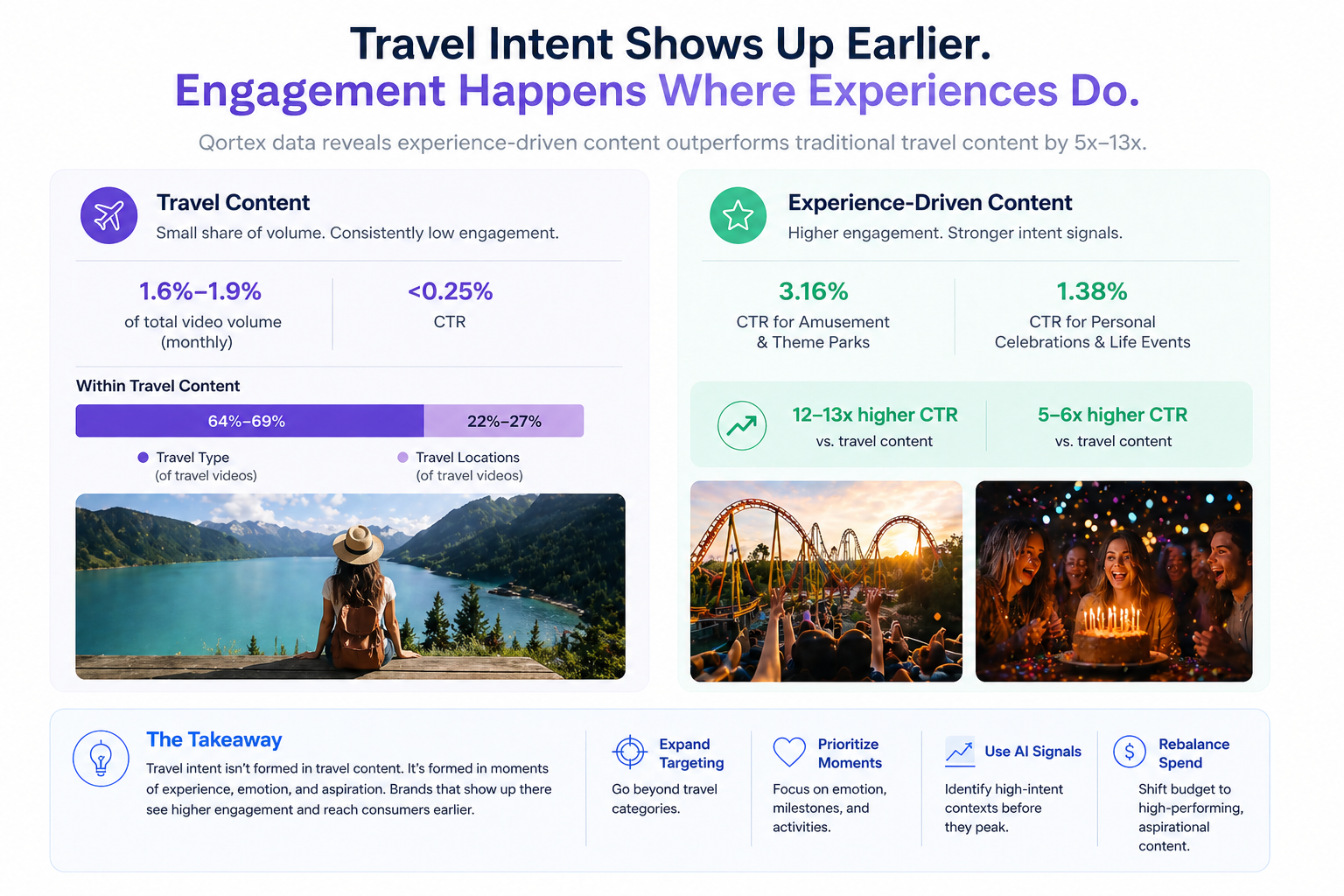
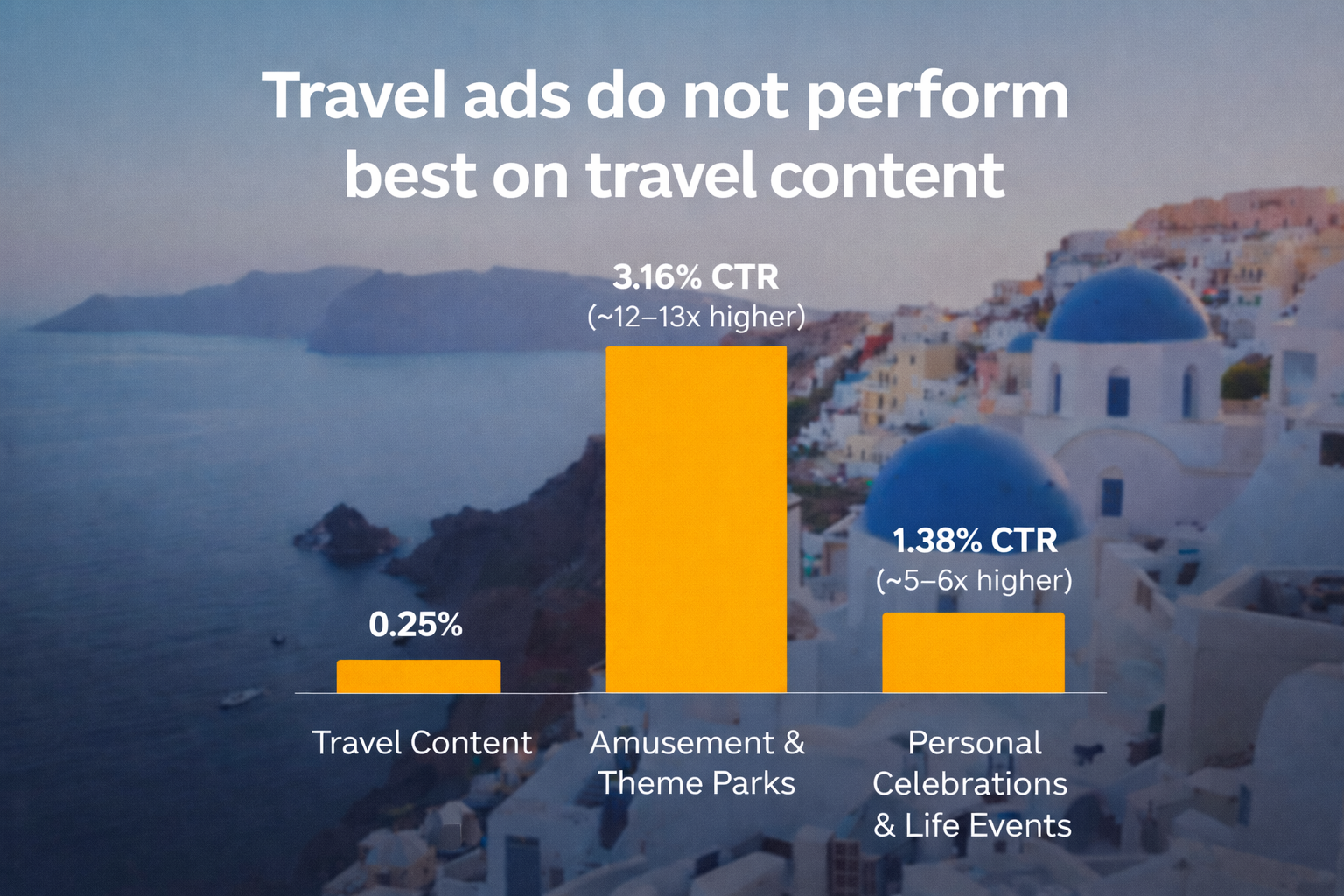
Travel content represents a relatively small share of total video consumption, accounting for roughly 1.6% to 1.9% of monthly volume. More importantly, it consistently underperforms in engagement, with click-through rates below 0.25%.
Even within the travel category, the distribution is predictable but not particularly effective. Content focused on travel types makes up the majority of volume, typically between 64% and 69%. Travel locations follow, accounting for another 22% to 27%.
Neither of these segments meaningfully drives engagement.
The implication is straightforward. Travel content is not where engagement happens at scale, even for travel advertisers.
Why Travel Content Underperforms
The issue is not relevance. It is context.
Travel content is highly immersive. Viewers are typically focused on the experience being presented, whether that is a destination walkthrough, a cinematic travel video, or a curated itinerary. That level of engagement makes them less likely to click away.
In other words, travel content is optimized for attention, not action.
This distinction matters. High attention does not always translate into high engagement. In many cases, it suppresses it.
Where Engagement Actually Occurs
When you shift the lens from category to behavior, a different pattern emerges.
Experience-driven environments outperform travel content by a wide margin. Categories tied to real-world activities and emotional moments consistently generate stronger engagement.
Amusement and theme park content delivers click-through rates around 3.16%, which is roughly twelve to thirteen times higher than traditional travel content. Personal celebrations and life events perform at approximately 1.38%, five to six times higher.
These are not marginal improvements. They represent a fundamentally different level of performance.
A Behavioral View of Travel Intent
To understand why this happens, it helps to rethink how travel intent forms.
Travel decisions are rarely made while consuming travel content. They are typically triggered earlier, in moments tied to emotion, change, or anticipation.
A more accurate model looks like this:
Intent begins with an emotional trigger. This could be a birthday, a milestone, a family moment, or simply a desire for change. From there, people move into exploring experiences, such as activities, events, or things they might want to do. Only after that do they begin to consider travel as a solution, followed by planning and booking.
Most travel marketing shows up at the planning stage. The opportunity is earlier, when intent is still forming.
The Expectation Gap
There is a consistent gap between where marketers assume intent lives and where it actually appears.
The assumption is that travel intent lives inside travel content. The reality is that it forms in adjacent environments, often tied to experiences rather than destinations.
This gap has real consequences. It limits reach, increases competition, and reduces efficiency.
What This Means for Travel Advertisers
Focusing exclusively on travel environments concentrates spend in a small, competitive segment of inventory that underperforms in engagement. It also means missing the earlier signals that indicate someone is becoming open to travel.
When advertisers expand beyond traditional travel categories and into experience-driven contexts, several things change. Engagement increases significantly. New audiences emerge that are not captured by standard targeting approaches. Performance improves without requiring additional spend.
This is not a function of better optimization. It is a function of better inputs.
Understanding behavior, rather than relying on predefined categories, changes where and how campaigns perform.
How to Apply This
There are four practical shifts that can be made immediately.
First, expand targeting beyond travel-specific categories and include environments tied to experiences, activities, and life moments.
Second, prioritize emotional context. Signals tied to milestones, routines, and aspiration are often stronger indicators of intent than category labels.
Third, focus on identifying early signals. Behavioral patterns often appear well before traditional indicators like search or site activity.
Finally, rebalance spend. Moving budget away from low-performing travel inventory and toward high-engagement environments can unlock both efficiency and scale.
The Role of Video Intelligence
At scale, these patterns are difficult to identify without deeper analysis of video content itself. Traditional categorization systems often miss the nuance within content, leading to mismatches between ads and actual viewer behavior. Qortex research has shown that video content can be misclassified at rates approaching 90%, which significantly impacts targeting accuracy.
Advanced Video Intelligence addresses this by analyzing what is actually happening within video content, including themes, sentiment, and behavioral signals. This allows marketers to align campaigns with the moments that matter, rather than relying on broad categories.
The Takeaway
Travel content is not where travel decisions are made.
It is where people observe.
The decision to travel begins earlier, in moments tied to emotion, experience, and change. Those moments are where intent forms, and where engagement is highest.
The brands that recognize this shift are not just improving performance. They are finding demand before it becomes visible to everyone else.